ANON BIT AD

Showing posts with label BLOCKCHAIN. Show all posts

Thursday, December 22, 2016

TAKEO NISHIKATA: Towards a Clearer Understanding of Blockchain's True Value

Towards a Clearer Understanding of Blockchain's True Value

 | Published on December 21, 2016 at 12:31 GMT
OPINION
Takeo Nishikata joined Nomura Research Institute (NRI) in 2008 and works on investigative research of advanced financial technology including blockchain and digital currency, as well as on development of innovative solutions. He is currently a technical lead for a proof of concept being developed with Japanese financial institutions.
In this CoinDesk 2016 in Review feature, Nishikata takes an expansive look at some of the discussion around blockchain, seeking to navigate and "clarify all the misunderstandings" around the tech at the close of the year.
coindesk-2016-review
navigation
According to a recent report from Gartner, blockchain is currently at the peak of a hype cycle.
At NRI, we have witnessed how this technology is misunderstood, and how it is at times either overestimated or underestimated. We have seen this during our continued investigative research on blockchain technology in the Japanese domestic securities field since the end of 2015.

Sunday, December 18, 2016

@@@POEM: FREEDOM IS AT YOUR FINGERTIPS!... DO YOU DARE?...

@@@POEM: FREEDOM IS AT YOUR FINGERTIPS!... DO YOU DARE?...


DEAR FRIENDS, 


ANOTHER GIFT OF NEW WAYS OF EARNING FUNDS... 
FUNDS FOR LIVING, FOR ENJOYING, FOR HEALING.... 

NOT MUCH YOU NEED TO DO, 
BUT TO JOIN, HAVE A FAITH ... AND TO SHARE...


SHARE YOUR SUCCESS WITH OTHERS,
BE NOT SO STINGY... AS THERE IS PLENTY... FOR ONE AND FOR ALL...


JOIN US AT BRAND NEW, AND VERY CLEAN APPROACH TO LIFE...
IF YOU SATISFIED WITH ENOUGH, THAN SHARE WITH OTHERS...


WHEN SHARING YOUR LINKS, YOUR SUCCESS... WITH OTHERS..
YOU WILL EARN EVEN MORE... SO IS IT A WAY?... OR WHAT?...

ALL YOU NEED IS TO JOIN... NOT TO JOIN ONLY @

AS WELL, OPEN ALTERNATIVE'S FOR PAYMENTS ON LINE...

FOR BITCOIN EXCHANGES TOO... SIMPLY  JOIN @
https://payza.com/  [ THIS ONE IS FOR SOUTH AFRICA... SO FOR YOUR COUNTRY YOU WILL HAVE ANOTHER OPTION...]

PLEASE, BE NOT LAY'ZEE... OPEN ALL THREE ACCOUNTS... AND SOME MORE... BITCOINS... COINOMIAS... ETHEREUMS... 

AS YOU WILL NEED THESE... TO SHARE YOUR WEALTH WITH OTHERS...

TO BUY BITCOINS OR ANY OTHER CRYPTO CURRENCIES...

TO BECOME FINLAY FREE OF OLD... FINANCIAL OPPRESSIVE SYSTEM...

SO, IF YOU HAVE ANY QUESTIONS TO ASK... 

HEAR MY VIDEOS... YOU CAN FIND MAYBE TOO HARSH...

YET I KNOW YOU ARE A BIG GIRL OR A BOY,... OR EVER A BOTH...
SO NO WORRIES IF YOU CHOOSE NOT...

IT WILL BE SOLELY YOUR OWN CHOICE TO STAY SMALL...
TO STAY IN THE DARKNESS OF YOUR TINNY SOUL... 

WHERE FLICKERING WILL DIMINISH WITH...
EXTINCTION OF OLD FAKE MONETARY FUND...

IF YOU NOT LIKE MY POSTS... PLEASE DELETE ME AS YOU DID MANY TIMES BEFORE.... PROBABLY WILL BE MY LAST...

OR NOT... WE WILL SEE... 
WE WILL EVENTUALLY AWAKE AS MANY AS MILLION ORGANIC HUMANS... 

TO BRING THE PROSPERITY TO ONE AND ALL...
TO ONE AND ALL ... CIAO... 

Thursday, December 15, 2016

Dutch City Trials Blockchain for Real Estate Contracts

Dutch City Trials Blockchain for Real Estate Contracts

 (@mpmcsweeney) | Published on December 12, 2016 at 14:00 GMT
NEWS
Deloitte's Netherlands branch is working with the city of Rotterdam to create a prototype for recording lease contracts on a blockchain.
In conjunction with the Cambridge Innovation Center (a real estate services firm based in the US), the project will focus on developing a platform for managing housing transactions. The area is one being explored by several startups, with the Rotterdam trial representing the latest effort to bridge the real estate industry and blockchain.
The first part of the process involved building a mechanism for recording lease agreements. From there, those involved with the project say, testing will move to payments for real estate transactions in conjunction with the agreement recording tool.
Jan Willem Santing, a manager of real estate advisory services at Deloitte, said in a statement:
"The next step will be monitoring the rental payments. By implementing additional blockchain applications in the real estate industry transaction times and costs can be reduced further. Furthermore, it enables decision makers to use data analysis for making future investment decisions on selling, buying and constructing real estate."
The effort is one of the more high-profile public sector blockchain initiatives to emerge in recent weeks, coming on the heels of news that the Port of Rotterdam, Europe’s largest shipping port, has been testing applications of its own.
It also comes amid a digital modernization effort being undertaken by both the national government in the Netherlands as well as municipal-level constituencies throughout the region.
Image Credit: Hit1912 / Shutterstock.com

Sunday, December 4, 2016

Fractional Reserve Banking is Obsolete... by Pierre Rochard

In the definitive treatise on Austrian Business Cycle Theory, Money, Bank Credit, and Economic CyclesJesús Huerta de Soto establishes the inevitability of economic crises wherever there is fractional reserve banking. All that is left for monetary scholars to do is analyze past crises and lobby the government to have the right reforms. Fortunately, for the first time in history, we are in the enviable position of not having to wait for reforms that may or may not lead to sound money. I explain why here.
My favorite part about the Bitcoin network is not that it makes society freer, more prosperous, or more just. My favorite part is that it will finally settle one of the longest debates in the history of economics: whether or not money printing and cheap credit are ever needed to stimulate growth.
Austrians know that artificial credit expansion inevitably causes a mispricing and misallocation of capital, whether it’s due to fractional reserve banking alone or in conjunction with a central bank. What is debated is the ethical legitimacy of fractional reserve banking, one side sees lending out deposits as inherently fraudulent while the other sees deposits as an especially liquid loan.
With a deposit, you are improving the custody and safe-keeping of your money and receiving other peripheral services (cashier and bookkeeping services), while at all times retaining the full availability of your money. You are relying on this service to lower the transaction costs of using your gold, silver, or government scrip. A superior service is built into Bitcoin.
  • Mathematically, there is no better custodian or safe-keeper for your money than an encrypted digital wallet. If you use strong passwords, back up your data, and secure your computer, then your bitcoins are safer than your person.
  • Bitcoin is the ideal cashier: it is available anywhere in the world with an Internet connection, it can make infinite amounts of change, and it can transfer money to any account almost instantly.
  • The distributed, unalterable blockchain puts banks’ bookkeeping and check clearing systems to shame.
With this level of perfect security and complete convenience there is no reason to deposit your money with a 3rd party. In other words, bitcoins make fractional reserve banking an obsolete technology, and bitcoin wallets are the best 100% reserve banks conceivable.
As Bitcoin adoption increases we will finally be able to “empirically validate" what Austrians have been arguing for decades: 100% reserve banking with a scarce medium of exchange prevents speculative manias, financial crises, and economic depressions.

 What is needed for a sound expansion of production is additional capital goods, not money or fiduciary media. The credit boom is built on the sands of banknotes and deposits. It must collapse.
 Ludwig von Mises

Friday, December 2, 2016

China's Huiyin Group Launches $20 Million Bitcoin Fund

China's Huiyin Group Launches $20 Million Bitcoin Fund

 (@corintxt) | Published on December 1, 2016 at 13:10 GMT
NEWS
screen-shot-2016-11-30-at-11-21-36-am
Huiyin Group, a multibillion-dollar investment company based in China, has announced the launch of Huiyin Blockchain Ventures (HBV), a subsidiary fund focused solely on investments in the sector.
Launching with $20m in committed capital, HBV will now seek to invest the funds over the course of the next six to 12 months. The fund will be managed by James Wo, the son of Huiyin Group founder, and focus on improving the blockchain ecosystem through investments in infrastructural projects and new use cases.
But while the firm may have "blockchain" in its name, those close to the fund suggested the firm is unlikely to invest in enterprise or so-called alternative blockchain projects.
Wo indicated that the fund will have a special focus on projects building on or otherwise supporting the bitcoin blockchain.
Wo said in a statement:
"We are seeking to invest into bitcoin-related companies to help enrich the industry, as we see a large opportunity for a return on our investment. As the bitcoin industry continually matures, the use of bitcoin will continue to grow and proliferate in China, as well as the rest of the world. HBV intends to be at the forefront of this technology as it continues to gain traction globally."
The firm has already started investing through their fund, backing Indian bitcoin brokerage Unocoin, content monetization platform Yours and Purse.io, a bitcoin-powered e-commerce marketplace.
Purse CEO Andrew Lee will also serve as an advisor to the fund.

Family business

For Huiyin Group, HBV's parent fund, the announcement follows its more recent move into the technology sector. (Huiyin Group is a family-owned investment group that has focused on traditional industries like real estate, energy and agriculture).
But in the past few years, Wo and his father have taken a personal interest in bitcoin, which ultimately led to the creation of the new fund.
Speaking about the family, Lee said:
"Out of all the investors I've spoken to [in China], they have a deeper commitment to bitcoin than anyone else, and probably the best economic and political ties to the Chinese economic machine to really further the bitcoin ecosystem."
Lee also hinted at much larger investment announcements in the bitcoin ecosystem to be revealed in the coming months.
China money image via Shutterstock

Tuesday, November 29, 2016

DAN No nations & borders — equal rights to all: Can Blockchain pave the way?:

No nations & borders — equal rights to all: Can Blockchain pave the way?

Today nations regulate peoples life on an unsustainable scale, suggesting not only what to hear, see or speak, but to a certain extent also what to think or how to act and react.
The tools are as manifold as the motivations behind these archaic actions. Be it propaganda and brain washing with advertising or staged news. Seldom solely to create an uniting enemy image, great for guiding public opinion to further corporate interests, clothed in security enhancements. At this point I will not go into further detail about the contemporary, eclectic taste in tv shows and reality programs.
Time to create a silver lining and come up with a platform for individuals to reclaim responsibility for their Selfs. Take matters into each our one hands and start saving this planet before it’s to late and we have to leave this rock of eden.
Bureaucracy is at an all time high - in developed countries and densely populated cities. This operational framework is vital to maintain a hierarchical or pyramid structure.
A structure old forces are trying to preserve in order to conserve their power.
A structure that is straining the individual with an archaic value system.
A structure most effectively in the age of industrialization, focusing on large manufacturing plants and the collective.
A structure that hinders and retards processes in the age of information technology.
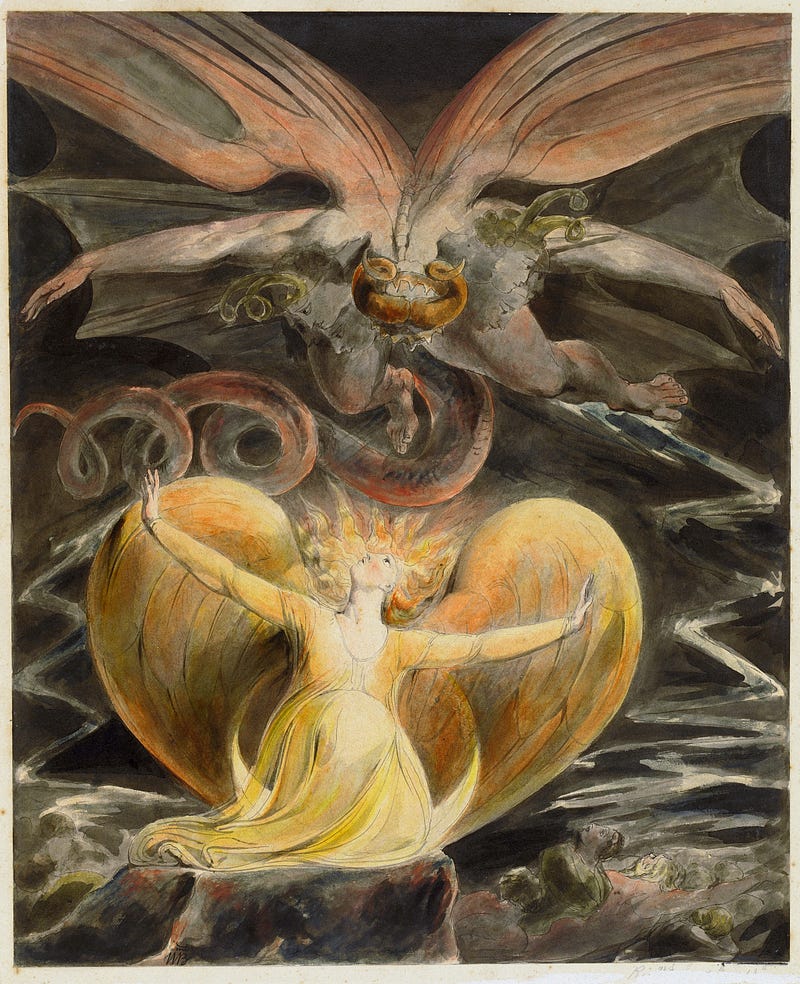
The Great Red Dragon and the Woman Clothed with Sun by William Blake
Iproclaim the system archaic in value because it was build on a world view, where the accumulation of material things is held up as the ultimate goal in life. Then again some people start to realize that this is complete nonsense — though some not until their mid-life crisis. Upon contemplation of life and existence many independent inquirers came to similar conclusions: in the end -that is the end of life- all that will matter to the rest of your dimming consciousness is to feel unconditional love. Life gifts us numerous opportunities to exercise this skill, but our past value system was not keen on educating the individual on their godlike abilities.
This is also the reason for the growing interest in esoteric and intangible things in our society. It is the collective psyche compensating for a harmful focus on the material world,
Let them soon tell tales about how in past years “No individual would take responsibility of their Self and they had a saying “Don’t worry, ‘the Man’ will take care of it.”. Just like we tell stories about the middle ages when 80% of the population could not read or write.

Oi Wei, but where to start?

There is a dream about a platform for individuals to reclaim responsibility for their Selfs and actions towards their peers and environment.
A kind of marketplace with the possibility for everyone (with an internet connection) to expose his skills, thoughts, services, physical or digital goods at will. Anyone else in the world may acquire said thing for a certain amount of coins or another thing in return.
No other regulators or service providers are involved, only the partaking peers and the network. Thus true value of meaningful products can be approximated and exchanged between peers freely.
Blockchain you say? SCALEABLE BLOCKCHAIN I say. An infinitely scaleableblockchain with evolving governance features would be a most suitable vehicle for an endeavor like this…
Is there any blockchain out there that can do this? If you know anything please leave a comment!
thanks for tuning in.

Thursday, November 24, 2016

POEM@@@HOW I BECOME MY OWN BANKER!.. AGAIN?!... by PSG...

POEM@@@HOW I BECOME MY OWN BANKER!.. AGAIN?!..by PSG...


YOUR TIME IS NOW... JOIN IN THE REVOLUTION THAT I SIMPLY CALL:
MINE-YOUR-OWN-MIND .. or better OWN-YOUR-OWN-BANK...
ALL YOU NEED IS TO CHOOSE...
TO STAND UP... AND SAY... YEAH... BABY.. I DESERVE IT!...
TIME IS UP FOR THESE BANKSTERS AND MARKET CROOKS...
TIME IS FOR ME TO GET MY OWN PRINTING CURRENCY MACHINE... HA!...

SO WHY NOT BE MY OWN LAPTOP, TABLET
OR EVEN A SMARTEST OF THE ALL: MY S-PHONE?...

TRY IT DUDES... IS IT SO MUCH TROUBLE FOR YOU TO TRUST? ..
ONCE MORE TIME.. .TRUST YOUR GUT..

KNOWING YOU DESERVE IT ALL...
JUST TRUST … THE WORLD COULD BE YOURS…

SIMPLE... LIKE 1,2,3... JUST LIKE EATING A CAKE...
YET THIS TIME.. AS YOU EAT: THE CAKE GETS BIGGER AND BIGGER...

EVERY TIME YOU CHOOSE TO GIFT YOUR TIME ...
BACK TO YOU OWN SELF.. DEAR ONE..

Saturday, November 19, 2016

COINDESK: The Swiss Government is Paving the Way for Crypto Banks...

The Swiss Government is Paving the Way for Crypto Banks

 (@DelRayMan) | Published on November 18, 2016 at 15:00 GMT
FEATURE

Swiss Parliament member Franz Grüter could hardly be happier that his proposal for new blockchain regulations has been shot down.
For months, he resisted the government's requests to kill his motion, which would have changed the definition of a bank to make it easier for cryptocurrency companies to open in Switzerland.
"We got this," was the gist of what they told him. "Thanks, but no thanks."
But Grüter, who was elected to represent the Lucerne region of Switzerland a year ago, remained skeptical.
"The reason I was frustrated was that I didn't believe how bureaucracies work, how bureaucracy works in governments," Grüter told CoinDesk. "I was not expecting that they would really say what they were writing. So, I kept my motion in place."
Two months later, he changed his mind. In August, the Swiss Financial Market Supervisory Authority (FINMA) (which oversees the nation's financial sector) finally convinced him what they were working on would amount to a real impact on blockchain companies — and soon.
Instead of lowering the amount of capital required for banks to keep on hand, the regulation currently being prepared will create an entirely new category of financial institution, he said.
Grüter calls this new breed of company a "crypto-bank," and since he's rescinded his own motion to change the law, he's pledged his support to these new financial entities.
Grüter told CoinDesk:
"I'm more than open to help the whole industry. If there are any further hurdles for them, we can eliminate those hurdles. Up to now, I can say my influence worked."

Square one

Grüter said he first became aware of the issues faced by cryptocurrency startups when he was approached by Xapo CEO Wences Cesares, who was then considering whether to move his bitcoin wallet provider's headquarters to Switzerland.
The information technology veteran and current chairmen of Swiss Internet firm Green.ch ended up receiving multiple "complaints" from blockchain entrepreneurs, and in order to better serve them, he sought the advice of local industry insiders.
Following the recommendation of Zug, Switzerland-based lawyer Andreas Glarner and the Switzerland Bitcoin Association founder Luzius Meisser, Grüter opened his first bitcoin account and began to experiment by purchasing the cryptocurrency.
Then, in May of 2015, Cesares officially moved Xapo's headquarters to the Zug region of Switzerland known as "crypto-valley". (He confirmed to CoinDesk that he continues his work with Swiss regulators and that he can't comment further).
This was soon followed by regulatory action.
The following month, Grüter and fellow Swiss Parliament member Claude Béglé collectively filed three blockchain-related motions. According to Swiss law, FINMA then had the right to recommend that such motions be passed, shot down or the ability to make a counter-proposal.
In this case, Grüter says he was unwilling to rescind or "liquidé" his own motion until he was contacted by a surprising source – the person who set him on on his cryptocurrency crusade, Wences Casares.
"Wences approached me and he told me, 'Hey Franz, you won't believe it, they are totally excited, they want to introduce now a new group of crypto-banks that has totally different regulations,'" Grüter said, adding:
"I decided there is no need at this point that I push it further since my intervention already worked and the government is making the changes proactively by themselves."

The future of 'crypto-banks'

Now that Grüter has rescinded his initial proposal, he says he’s only getting sporadic information about the future of these new financial entities.
But thanks to a series of public documents, the crypto-banks makeup is beginning to take shape.
Just days after Swiss rail operator SBB announced it would begin offering bitcoin via its ticket kiosks, Switzerland's Federal Department of Finance (FDF) published the first details about the project.
Revealed earlier this month, these so-called "FinTech licenses" may be granted by FINMA with capital requirement as low as CHF 300,000, or 5% of the accepted public funds. (The total amount of public funds that can be accepted by those with a FinTech license may not exceed CHF 100m).
The day before the FDF published the license details, FINMA released a corresponding document that helped lay the framework by redefining corporate governance guidelines for banks.
Specifically, the document instituted the proportional application of certain regulations, "leaving institutions free to implement the requirements in a way that takes account of their differing business models and of the particular risks associated with them."
But that isn't all. Yesterday, FINMA defined its strategic goals for the four years beginning in 2017. The document explicitly mentions a "pro-innovation approach to supervision and regulation, and tackling newly emerging risks," as among the regulator’s top priorities.
From the document:
"The long-term success of Switzerland's financial centre depends largely on its ability to innovate. FINMA is therefore adopting a more pro-innovation approach to regulation and supervision and will push for the removal of unnecessary regulatory obstacles for innovative business models."

The mind shift

Though an exact timeline has yet to be published, Switzerland’s Federal Council has instructed the FDF to complete a draft of its legislative amendments by the beginning of next year.
Some of the proposed measures could even be enacted by an executive order at an earlier date, according to Bitcoin Association Swtizerland founder, Luzius Meissner.
As part of that work, the FDF is expected to join forces with related authorities to clarify certain stipulations and further reduce barriers for FinTech startups.
According to Grüter, behind all these changes is nothing less than a total shift in the way Switzerland views cryptocurrency startups.
Instead of being focused on the potential risks, Grüter argues that his colleagues have determined to prioritize the potential benefits.
"The mindset is completely changing now from a certain critical, not really knowing what are the threats of the technology to a very open-minded, opportunity-driven people," said Grüter.
Meisser reiterated Grüter’s position, but more cautiously.
"It is great to see that the government finally starts to think about realizing opportunities instead of eliminating risks. Often, governments tend to overemphasize the latter while neglecting the former," he said.
"However, it is too early to cheer. It remains to be seen which suggestions actually will survive the political process."

Bitcoin where his mouth is

Since Grüter opened his bitcoin account with BreadWallet earlier this year, he said he’s mostly just focused on how to buy the digital currency and track its price changes.
But over the coming months, he expects to make his first bitcoin purchase using the wallet.
Already, the canton of Zug has voted to accept bitcoin for payment of certain government services, with further evaluation by the end of this year.
But as the SBB plan to start accepting bitcoin goes into action, he thinks his first purchase will be for a ticket to ride.
Grüter concluded:
"This makes it much more widely public now, and probably I will use it mostly there."
Image via Franz Grüter; Shutterstock